Tibet Trails
定制我的行程
Thangka Painting: Inside Tibet's Sacred Scroll Art
Culture·10 分钟阅读

Thangka Painting: Inside Tibet's Sacred Scroll Art

A thangka is far more than a beautiful picture. These sacred Tibetan scroll paintings follow centuries-old rules of proportion and pigment. Here is how they are made, and how to read them.

Step into almost any Tibetan monastery and you will see them: luminous painted scrolls, framed in silk, glowing with mineral colour. These are thangkas, and once you understand a little of how they work, they become some of the most rewarding things to look at in all of Tibet.

They are not decorative posters. A thangka is a precise spiritual instrument, made by rules that stretch back centuries.

What a thangka is

A thangka is a Tibetan Buddhist painting on cloth, usually cotton or silk, mounted in a brocade textile frame so it can be rolled up and carried or unrolled and hung. That portability mattered in a land of monasteries, pilgrimage and nomadic life.

Thangkas serve devotion and meditation. They depict buddhas, bodhisattvas, protective deities, great teachers and symbolic diagrams such as mandalas. A practitioner may use one as a focus for visualisation, contemplating the figure's form, gestures and meaning. The image is a support for the mind, not merely art for a wall.

Proportion is sacred

Here is what surprises many visitors: the artist is not free to draw a deity however they like. Sacred figures must follow strict iconometric proportions set out in traditional texts, a kind of divine geometry.

  • Before painting, the artist lays down a precise grid of measured lines.
  • The proportions of a buddha's body, the spacing of the eyes, the length of the limbs, all follow prescribed ratios.
  • Each deity has defined attributes: posture, hand gestures, colours, and the objects they hold.

This is why thangkas of the same figure look consistent across centuries and regions. The rules ensure the image is not just beautiful but correct, so it can properly serve its religious purpose. Creativity lives within the framework, not against it, expressed through landscape, ornament, colour and refinement rather than through reinventing the figure.

How the colours are made

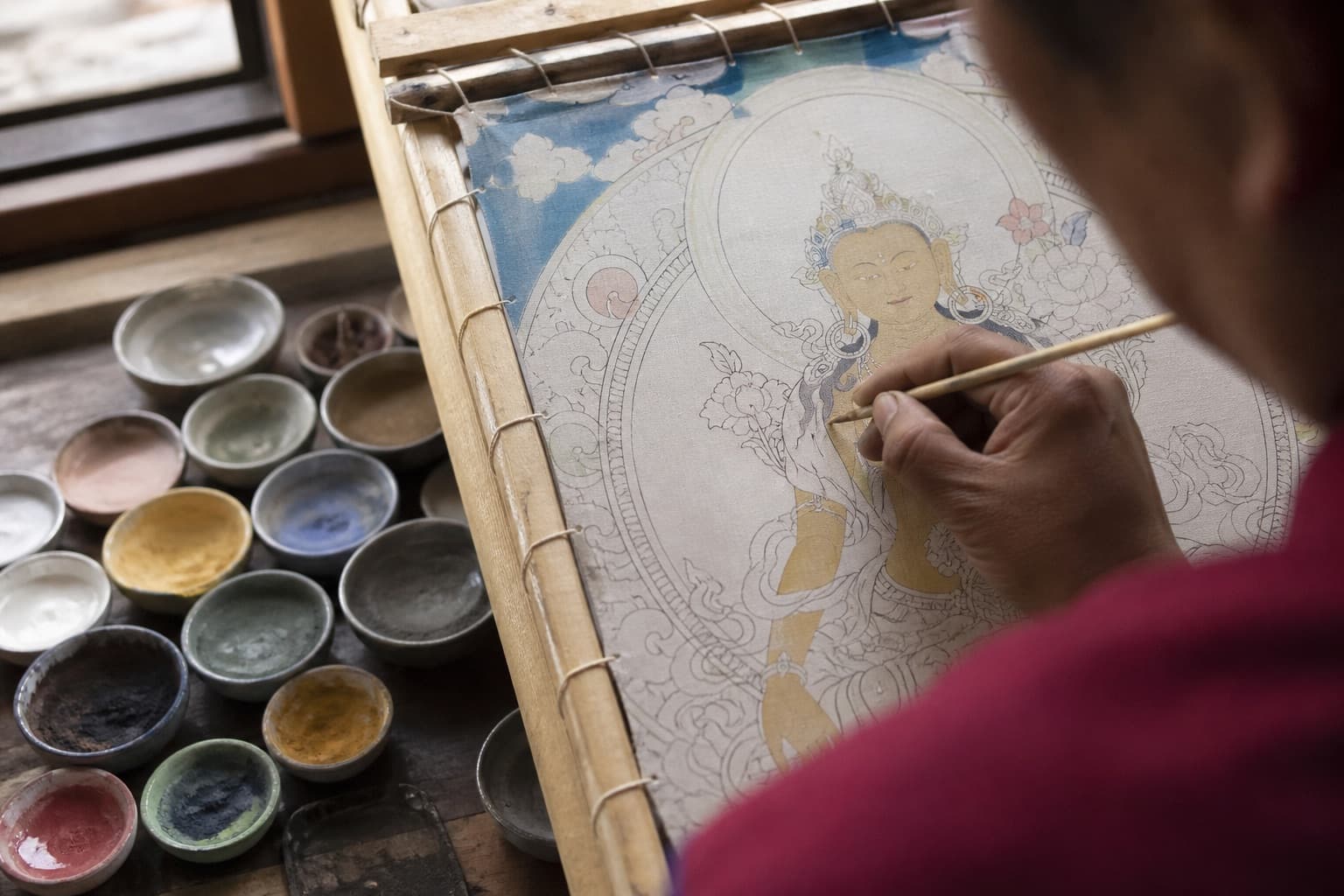
The glow of a fine thangka comes largely from its materials. Traditionally, pigments are ground from natural minerals, prized for their richness and durability:

  • Blue from lapis lazuli.
  • Green from malachite.
  • Red from cinnabar and other mineral and organic sources.
  • Whites, yellows and earth tones from further minerals.
  • Gold, applied for haloes, fine detail and inscriptions, often burnished to a shine.

Preparing these pigments is itself laborious: minerals are crushed, washed and refined, sometimes through repeated purification to achieve depth and purity of colour. Binding them with organic media and applying them in careful layers gives the finished work its characteristic luminosity. A single elaborate thangka can take weeks or months to complete.

Schools and styles

Over time, distinct artistic traditions emerged. Three are often singled out among the major Tibetan painting schools:

  • Menri: Associated with the master Menla Döndrub around the fifteenth century, known for classical, balanced compositions and serene figures, and influential across central Tibet.
  • Khyenri: Developed by the artist Khyentse Chenmo, noted for a bright palette, fine detail and expressive faces, including powerful depictions of wrathful deities.
  • Karma Gadri: Flourishing in eastern Tibet, distinguished by more spacious, naturalistic backgrounds influenced by Chinese landscape painting, with flowing lines and rich colour.

These traditions share the same sacred rules of proportion and iconography while differing in mood, background treatment and brushwork. Recognising them is a lovely way to deepen what you notice.

How a thangka is made

The craft unfolds in patient stages, each demanding discipline:

  • Preparing the ground. Cotton cloth is stretched on a frame and treated with a gesso-like coating, then smoothed and polished so the surface takes pigment cleanly.
  • Drawing the grid. The artist lays out the iconometric guidelines and sketches the figures within those measured proportions.
  • Laying colour. Mineral pigments are applied in careful layers, building from broad areas to fine detail, with shading and outlining to give form.
  • Adding gold and detail. Gold is applied and burnished, faces are completed last, and fine linework brings the figures to life.
  • Mounting. The finished painting is sewn into a brocade frame, often with a silk cover that protects the image and is lifted to reveal it.

For sacred works, this is approached as a devotional act as much as an artistic one, undertaken with care and the right intention.

How to look at a thangka

You do not need to be a scholar to read one with more attention. A few prompts help:

  • Find the centre. The principal figure usually sits at the heart of the composition, larger than the rest.
  • Read the surroundings. Smaller figures, teachers, attendants, protectors, are often arranged around the centre and along the borders.
  • Notice gestures and objects. Hand positions and held items identify the figure and convey meaning.
  • Look at the background. Spacious landscape may suggest an eastern style; dense, formal arrangement may point elsewhere.
  • Catch the gold. See how light moves across burnished detail as you shift your view.

A thangka rewards slow looking. The longer you stay with one, the more its order, symbolism and craftsmanship reveal themselves.

Respect and authenticity

Thangkas are living religious objects, so treat them respectfully in monasteries: follow photography rules, which are often restricted, and avoid touching. If you wish to buy one, quality and price vary enormously. Genuine hand-painted thangkas using traditional methods take great skill and time, and cost accordingly, while mass-produced prints are a different thing entirely. A reputable workshop and an honest guide make all the difference.

Seen with a little understanding, thangkas stop being background colour and become one of the richest windows into Tibetan culture. To visit the monasteries where they hang, explore our Tibet tours or reach out via contact.

与我们一起规划您的西藏之旅

许可证全程办妥、本地向导、价格透明。告诉我们您的日期,我们将为您定制行程。

常见问题

A thangka is a Tibetan Buddhist scroll painting used mainly for devotion and meditation. It depicts buddhas, deities, teachers or mandalas, and a practitioner may use it as a focus for visualisation, contemplating the figure's form and meaning. Mounted in a textile frame, it can be rolled for transport and unrolled to display, suiting monastic and pilgrimage life.