Beyond Mount Kailash, a vanished kingdom's cave-cities and painted temples sit above the Sutlej valley. Here's what the Guge Kingdom was, why its ruins survive, and how travelers reach them.
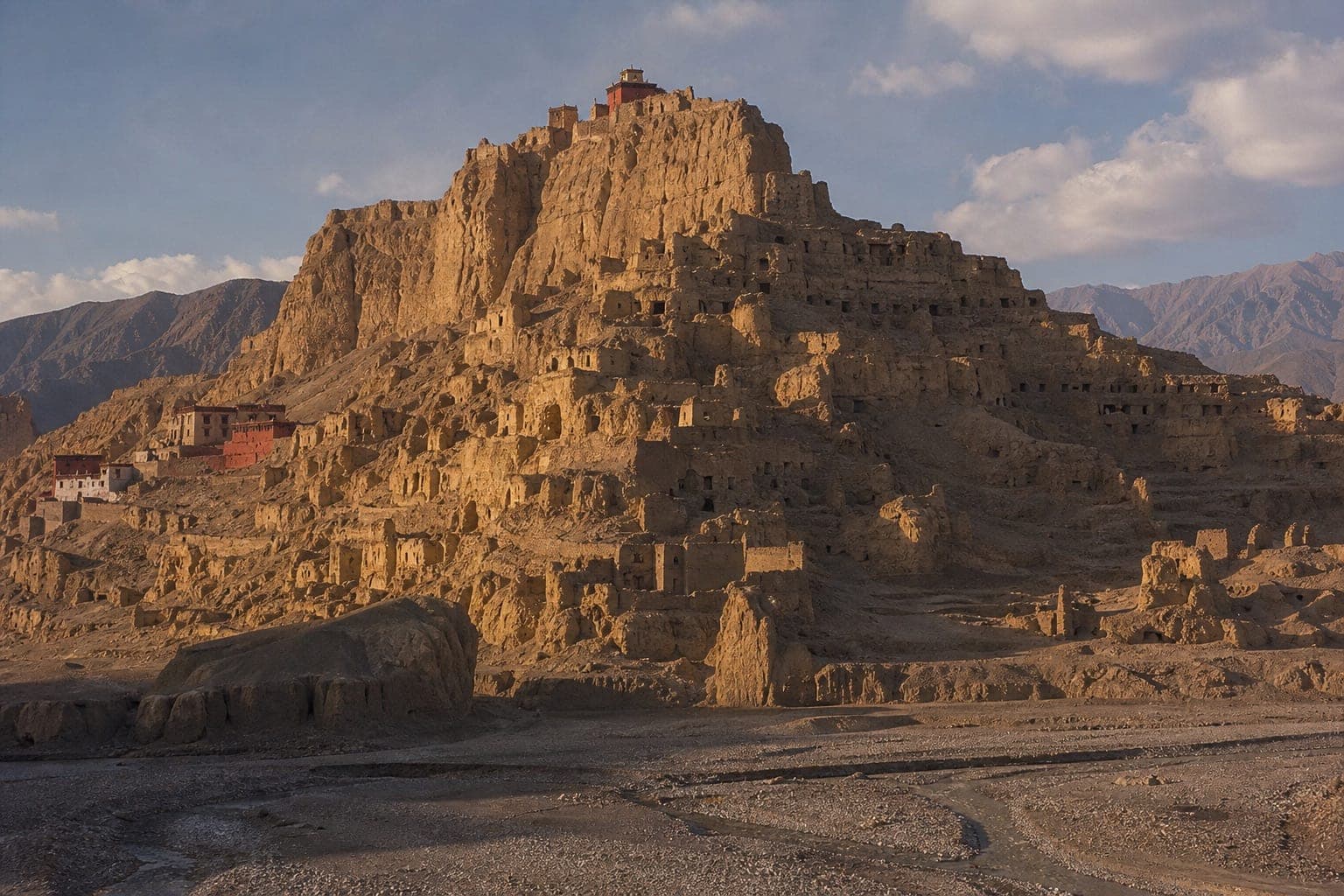
Quick answer: The Guge Kingdom was a Tibetan Buddhist kingdom that rose in the far west of Tibet after the empire's collapse in the 9th century and lasted roughly seven centuries before it fell in the 1630s. Its ruined capital, Tsaparang, is a honeycombed hillside city of tunnels, chapels, and cave dwellings carved into a lone ridge above the Sutlej River, with wall paintings that rank among the finest surviving Buddhist art in the Himalayan world. It sits deep in Ngari prefecture, a long way past Mount Kailash, and is reached almost exclusively as an extension of a Kailash kora itinerary.
Most travelers who make it to Mount Kailash never hear about what lies another day's drive further west. Above the market town of Zanda (Zhada), a ridge of eroded clay rises out of the Sutlej valley, and carved into it is the abandoned capital of a kingdom that once rivaled central Tibet in wealth and religious influence. Guge is one of the least-visited great sites in the Himalayan world, not because it lacks significance, but because reaching it costs several extra days of hard overland travel that few itineraries can absorb. For travelers who do go, it is often the most striking single place on the whole trip.
What the Guge Kingdom Was
When the Tibetan Empire fragmented in the 9th century, a royal descendant fled west and, over the following generations, his line built a new kingdom out of the remote Ngari region. Guge grew into a genuine power, controlling trade routes between Tibet, Ladakh, and the Indian plains, and — more importantly for what survives today — it became one of the great centers of the so-called "second diffusion" of Buddhism into Tibet. The kingdom's kings sponsored translators and monasteries and, in the late 10th century, invited the Bengali master Atisha to teach at Guge before he carried on to central Tibet, a visit still regarded as one of the pivotal moments in Tibetan Buddhist history.
That royal patronage produced Tsaparang and its sister site Tholing: cities and monasteries built not for a large population but for scholarship, translation, and art. For several centuries Guge prospered in relative isolation, protected by its remoteness and the sheer difficulty of the terrain around it. That same isolation is why so much of what was built has survived largely undisturbed — there was little reason for anyone to come and destroy it after the kingdom itself was gone.
Guge's end, in the 1630s, came from a war with the neighboring kingdom of Ladakh. After a prolonged siege of Tsaparang, the royal line was broken and the kingdom's independence ended. The city was not immediately destroyed, but it was gradually abandoned over the following generations as the region's center of gravity shifted elsewhere, leaving the hillside largely as it was left.
Tsaparang: The Honeycomb City
Tsaparang is unlike any other ruin in Tibet. Rather than a fortress or a monastery complex in the usual sense, it is an entire settlement — palace, temples, and dwellings — carved into and built onto a single steep clay ridge, connected by tunnels and stairways bored through the rock itself. Climbing through it means passing between levels via dark passages rather than open streets, emerging at intervals into small chapels and terraces with views out over the valley.
The surviving temples are the reason the site matters so much art-historically. Chapels including the Lhakhang Karpo (White Temple) and Lhakhang Marpo (Red Temple) hold wall paintings — mandalas, protector deities, scenes of Guge's royal court — in a distinct local style that blended Kashmiri, Indian, and Nepalese influences with Tibetan iconography. Because Tsaparang was abandoned rather than destroyed, and because the dry western Tibetan climate is kind to pigment, murals that are many centuries old retain colors and detail that are hard to find anywhere else on the plateau. Some chapels also preserve fragments of the royal mummies and statuary, though much of the site's portable art was lost or removed over the centuries.
At the summit of the ridge, the remains of the royal palace and a war room look out over the Sutlej valley in every direction — a reminder that this was, for a period, a functioning capital with real strategic concerns, not merely a religious retreat.
Tholing Monastery
A short distance away, in the town of Zanda itself, stands Tholing Monastery — Guge's royal monastery, founded around 996 CE by the king Yeshe-Ö. Tholing was where much of the kingdom's serious religious work happened: the great translator-scholar Rinchen Zangpo worked here on Sanskrit Buddhist texts, and it was Tholing that hosted Atisha before his onward journey to central Tibet. The monastery has been damaged and restored across its long history, and what stands today is smaller than its original footprint, but its main halls still hold notable early murals and give a sense of what a working Guge-era monastery looked like, as a companion visit to the more dramatic ruins at Tsaparang.
The Zanda Earth Forest
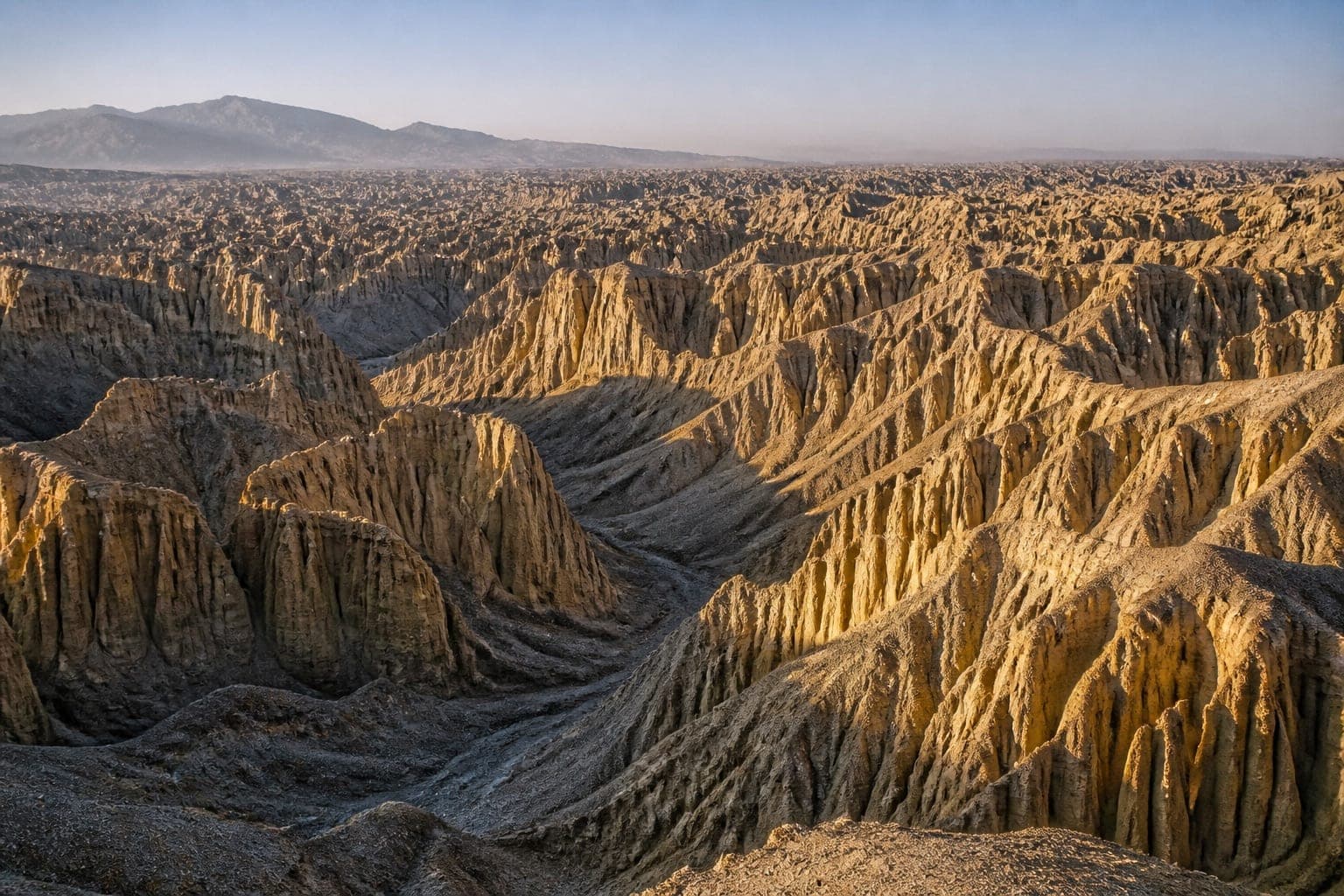
The drive between the Kailash region and Zanda passes through one of Tibet's strangest landscapes: the Zanda earth forest (Tuja Cun), a vast expanse of eroded canyons and clay pinnacles carved by wind and water out of an ancient lakebed. The formations stretch for a long way along the Sutlej valley, and the light in late afternoon — when the road typically passes through — turns the canyon walls gold and orange. It's a striking, almost otherworldly setting for a lost kingdom, and for many travelers the drive itself is as memorable as the ruins at the end of it.
Where Guge Fits in a Tibet Itinerary
Guge is not a destination anyone reaches on its own. It sits deep in Ngari, far beyond Mount Kailash, and the only realistic way to see it is as an extension of a Kailash trip — which itself already requires a long overland itinerary from Lhasa. In practice this means Guge belongs only on itineraries of roughly two weeks or more, built around the Kailash kora with several extra days added for the push west to Zanda and back. Our 14-Day Mount Kailash Kora & Guge Kingdom Tour is built exactly this way: the kora comes first, then a push southwest into the earth forest and a day among the Tsaparang ruins and Tholing, before the long drive back east.
Because the region is classed among Tibet's restricted areas, the same permit rules that apply to Kailash apply here — a Tibet Travel Permit, an Alien's Travel Permit, and a Frontier Pass, all arranged by your operator as part of an organized, guided tour. See our Tibet Travel Permit guide for how that paperwork works, and our guide to Tibet's travel restrictions for the broader picture of where foreign travelers can and can't go independently.
Practicalities
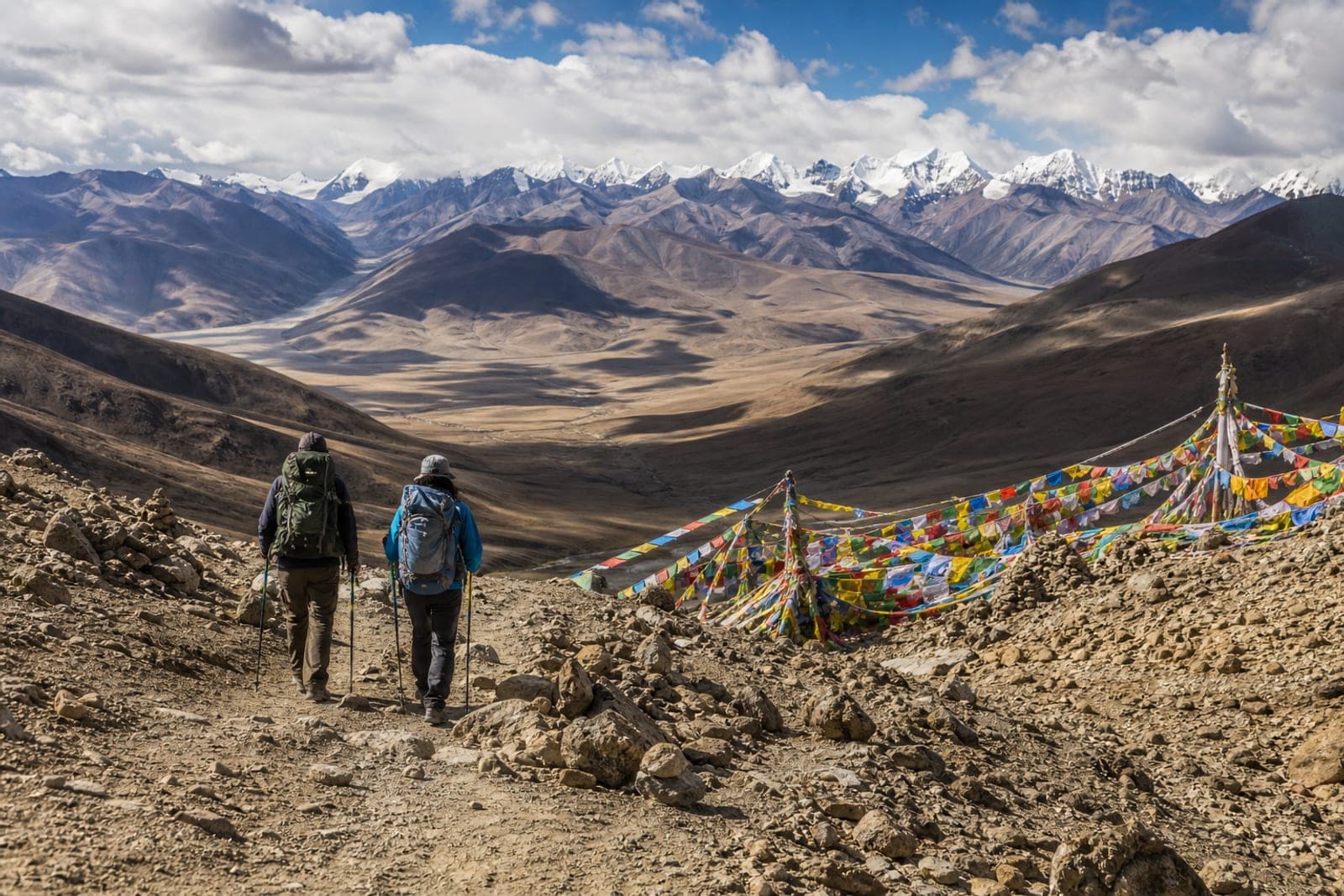
Travel in Ngari is genuinely remote. Roads are long, settlements are small and basic, and the region sits at consistently high altitude throughout — Zanda itself is lower than Darchen, which for most travelers comes as a welcome break after the kora, but it is still well above sea level and days either side involve high passes. The practical season mirrors Kailash: roughly mid-May to mid-October, when roads are clear and passable. Outside that window, conditions in far-western Tibet become considerably harsher than in central Tibet.
Because Guge is always the far end of an already demanding itinerary, it makes sense only for travelers who have already committed to the Kailash region and want to go further. If that's you, it rewards the effort — few places in the Himalayan world combine this much history, this much surviving art, and this little foot traffic.
Explore the 14-Day Mount Kailash Kora & Guge Kingdom Tour, read more about the Kailash pilgrimage that precedes it, or contact us to talk through whether a western Tibet itinerary is realistic for your timeframe.
Planifica tu viaje al Tíbet con nosotros
Permisos gestionados, guías locales y precios transparentes. Cuéntanos tus fechas y te enviaremos un itinerario a medida.
Preguntas frecuentes
Guge was a Tibetan Buddhist kingdom founded in far-western Tibet in the 9th or 10th century by a royal line that fled the collapsing Tibetan Empire. It became an important center of Buddhist scholarship and art, lasting roughly seven centuries before falling to a war with neighboring Ladakh in the 1630s.